
Medical Advocacy
There are any number of harsh images that stay with me over the years in Phnom Penh. One of them is Srei On. The memory I have is her kneeling down outside a cafe begging people for

Srei On
fifteen dollars to see a local doctor. She was crying and genuine in her request. Her partner had been picked up by the police for rough-sleeping and indefinitely detained. She was pregnant and from the way she was acting and aging, I’m certain she was an occasional meth user at best.
Like many people in a similar context in the area, she was illiterate and had no idea how to access Cambodia’s state care system. In the mad times that were COVID back then, there was some arrangement to try taking her to Calmette, the local state hospital, but she died before anything was arranged. As I recall, and also like most people in that context, she had no ID or papers; locals usually leave these documents in the province for safety when travelling to the capital, for safety reasons, but it means that, outside of NGOs, state care is difficult to access.
It makes me wonder what would have happened if she had lived a few days longer. Turning up at the state hospital with no papers, supported by a few stranded expats who were also in a semi-homeless situation themselves due to the madness that was the pandemic. I think the outcome might have been just as tragic but with even more pointless frustration.
As extreme as this situation sounds, it’s a fairly common occurrence in the community. Another lady known simply as ‘Da’ had serious symptoms but was able to raise the funds to
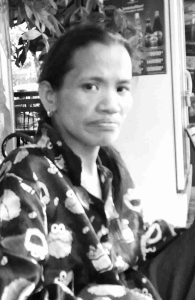
Srei Da
see a French Doctor in Daun Penh, where an X-ray revealed a stomach tumour. She reached out and this was some time after COVID when things were more settled and it was easier to
arrange things. She was actually quite an educated woman who had worked in a child focused NGO before the close down. I suggested using the state care in Calmette as she did have papers and a supportive family but she was adamant that you only go there ‘if you want to die’.
There was time to arrange something and I let a few patrons know the situation. As is often the case, treatment costs can be reasonable in the region when available, and Cambodia is vastly improving the standard of care every year. I was able to give her the few hundred in cash that she needed and told her to keep us informed.
She disappeared a while after that and I was informed that she’d gone home to the province to recuperate. I had to leave the capital for a few months and when I returned her friends told me she had died. The last time she had been to visit she had family with her and was fully delusive. It was explained to me, ‘If she had have seen you, she would not have known you’.
Nobody seemed to know the full details of the story but eventually I found her husband who explained that she’d ended up using the money on living expenses and giving it to her extended family, who possibly didn’t know the gravity of the situation.
This can also be an issue. It isn’t just being literate or educated enough to understand how to access a state medical system but also the financial resources needed to obtain care. People like Da living in impoverished conditions are not isolated individuals but part of a community that is collectivist in nature and cares for each other and when relatively large sums of money can be obtained for treatment, in the hands of an individual surrounded by need and obligation, that finance often cannot translate into actually obtaining care.
This access to care isn’t even a local-only issue. Many people in the region are from developed countries but excluded economically, and also medically. For example, one friend was an artist, living hand to mouth but with an American passport. When his intestines started pushing out of his stomach he was a type of medical refugee, not entitled to medical care in his home country and this was quite some time ago when local care was only for emergencies and the bare minimum was travel to Vietnam. He was able to obtain funds from a friend he had helped to write a book but then found the local system in Saigon challenging to access in terms of information, communication and logistics.
People are excluded in different ways; it can be financial, but also by complexity of the system. I think it’s a shared struggle that is only going to increase. As AI transforms our world there are going to be far more economic refugees, digital nomad types and early retirees whose lives make better financial sense in South East Asia, but are not necessarily going to be well-insured. Even if they are affluent there is the question of navigating the system. Is it really so different? Cambodia does now have a new and far more comprehensive social security system, but many locals don’t know it exists, let alone how to navigate it – and there is always the recurring issue of documentation for the homeless population.
How I see the role of ShadowVoices
Bridging the Paperwork Gap: For a lot of people in Phnom Penh, the state system might as well not exist if you’re illiterate or your ID is stuck in a province ten hours away. I want to act as a bridge, helping people navigate the new social security systems and the bureaucracy that usually just shuts the door on them.
Direct-to-Care Funding: I’ve seen that just handing over cash doesn’t always work when someone is drowning in communal debt or family needs. I’m working on a framework for “Crowdsourced Healing”—getting funds directly to the treatment providers so that the money actually buys the surgery or the medicine it was meant for.
Opening the Supply Pipeline: I’m reaching out to the big medical manufacturers and the local distributors to figure out why the “good stuff”—the specialized hardware and life-altering tech—is so hard to find here. I want to understand their hurdles so I can better advocate for the consistent availability of specialized medical technology (such as advanced orthopaedic systems) across the region.
The Shared Struggle: I don’t see a huge difference between a local struggling to find a doctor and a Westerner who’s been priced out of their own country. Whether it’s an American artist with a hernia or a Cambodian mother with a tumour, the “lottery of birth” has failed them both. I believe your ability to heal shouldn’t depend on your passport or how well you can read a registration form.
I also have recently had the idea of a new funding model. Recently I’ve had to navigate the whole medical system for my own needs, and even having been in the region for over three decades and being bilingual – it is an ongoing struggle. If there was someone who knew how to get me the things I need I would happily pay them. How hard must it be for a ‘medical refugee’ arriving in the region? Not able to access state care in their own country for whatever reason, essentially they become a ‘forced medical tourist’. Such people aren’t necessarily struggling financially—regional care is many times cheaper than in the West—but the navigation is challenging, especially for someone not used to the region or local bureaucracy. I have a feeling that if I was able to help such people with logistics etc. with a fee-paying model where money isn’t the issue, the revenue generated could fund local cases where money *is* the issue. I’m currently working on this but stay tuned here for updates when I have solved my own health issues.