
Tien – A Vietnamese National who Avoided Addiction and Solved her own Homelessness Issue in Phnom Pehn

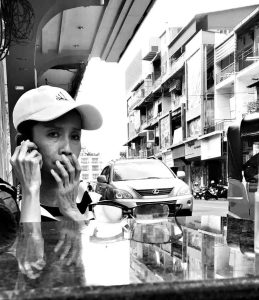
Tien
I met Tien at the very start of covid when none of us had any idea how long it would be going on for. She was Vietnamese (well, still is, and we’re still friends), and had been living in Bangkok for many years. Previously, she’d been married to a rich guy from Taiwan and had an apartment in Bangkok, but he’d died suddenly. She is trilingual (English, Vietnamese and Khmer) and so got a job with a Thai tour company bringing Vietnamese tourists from Saigon to Bangkok by bus. She was making very good money, I think it was a few thousand a month (usd) and when covid struck and the borders closed she was trapped here.
At the beginning, when it wasn’t obvious how long it would all go on for, the Thai company rented an apartment for her for a month – waiting for the border to open. Well of course the border was closed for more than a year, and when the scope of the pandemic became obvious, the company cut her loose, she went to the three dollar a night Indian dormitory and essentially was begging for a living.

Tien, in the now defunct three dollar a night Indian dormitory in street 271, Phnom Pehn.
She had a friend in Naga casino whom she knew from the days when she would take all the Vietnamese tourists there so she was allowed to sleep on the floor once in a while. She occasionally found work cleaning someone’s apartment.
She would hang around places foreigners frequented and had a rich boyfriend for a time. Sometimes she wasn’t lucky, and couldn’t even rustle up even the three dollars to pay for the bed. Then she would sit up all night in the 24 hour bar, and other times she would come to my door late at night and ask to borrow five dollars.
One morning, and this is nothing to do with her, my best friend died suddenly (in Phnom Pehn). Well it was a shock and I was in mourning – and the same day I got this rambling call from her that she wanted to pay all the money back. I tried to tell her no but she absolutely insisted and told me where to meet her. This was when she had a gentleman friend who was driving her around. I wanted to leave the city for the day because of my grief but there was no reply when I called her, so I went to the arranged place and she didn’t show but eventually called again and asked me to go somewhere else, and this went on all day and eventually it was dark. I waited in the last location and never saw her. One of the worst days of my life and I was tied up like this.

Well a few days later she called and asked me to meet her as if nothing had happened – and I said I don’t want to be friends, basically. I bumped into her a few times but cold-shouldered her. Eventually, after a couple of years, we are back of speaking terms but not close. She has a permanent job cleaning in an Indian hotel. I think she’s been there for over a year.
I think she did incredibly well considering the cards she was dealt in life, and it goes to show how things can turn. She never had an issue with meth, and a reason could be that she never stayed in the slum where it’s easily available, either sleeping in the Indian dorm or staying up in the restaurant. Possibly being Vietnamese-born she was less comfortable going into the slum, and so that was actually a protective factor, and this is one more reason to set up a ‘no ID required’ hostel for the newly homeless in Phnom Pehn, away from other users and dealers.
Would a direct donation (sizable rather than the fives I was giving her) have saved her from homelessness. No. I don’t think so. I want to include this story to illustrate the variety of experiences when talking about homelessness in Phnom Pehn. Another thing I think this story illustrates in that Tien’s history has a long period of stability, and she managed to get herself back on her feet, whereas the people I know who never seem to get on their feet, seem never to have been at all in the past. I think this is something to bear in mind when assessing peoples’ suitability for direct payments.